Use the space bar or arrow keys to browse the slides.
require 'typecheck'

class Checked
  extend Typecheck

  typecheck '[Fixnum], String|#upcase -> Symbol',
  def foo(x, y)
    :z
  end
end

Checked.new([1,2,3], 'foo')
#=> :z
Checked.new([1,2,:z], 'foo')
#=> raise Typecheck::TypeError
Functional Programming in Ruby
RubyConf Taiwan 2014
by Arne Brasseur / 白阿仁 / @plexus

Functional Programming
Values
Functions
Runtime support
Values
Variables
A name for a place
What’s in the place changes over time
x = 3
x = 5
x = nil
Values
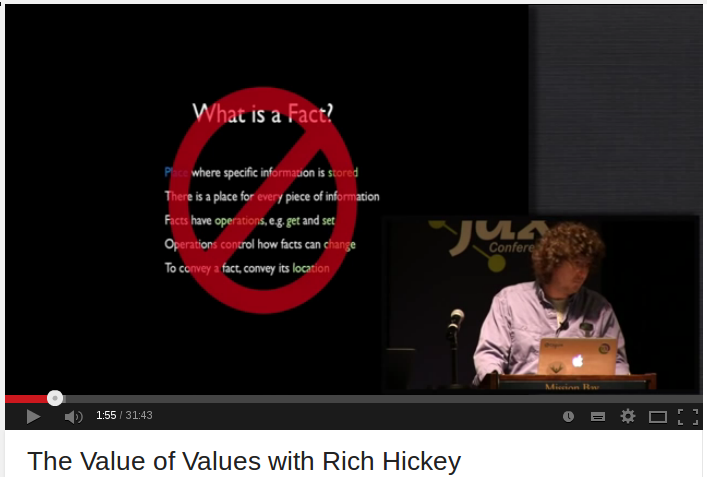
An unchangeable fact
Different values can reflect facts related to different times
{ date: '2014-04-24', temperature: 27 }
{ date: '2014-04-25', temperature: 29 }
Why Values?
Safe to share
Easy to reason about
Make the best interfaces
Values in Ruby
true, false, nil
23, 42, 5.9999
:foo, :bar
Time, Date, Pathname
Values by Choice
The biggest virtue of a Ruby programmer is discipline
Make liberal use of freeze
Aggregates of values are also values
Example
class HTMLElement
  attr_reader :tag, :attrs, :children

  def initialize(tag, attrs, children)
    @tag      = tag
    @attrs    = attrs.freeze
    @children = children.freeze
  end

  def set_attr(attr, value)
    self.class.new(
      tag,
      attrs.merge(attr => value),
      children
    )
  end
end
gem 'anima'
gem 'adamantium'
class HTMLElement
  include Anima.new(:tag, :attrs, :children)
  include Anima::Update
  include Adamantium

  def set_attr(attr, value)
    update( attrs: attrs.merge(attr => value) )
  end
end
per·sis·tent
/pərˈsistənt/
adjective
Continuing to exist or endure over a prolonged period.
per·sis·tent
Old version stays available after “change”
Can be done in an optimized way
Persistent Collections
Share memory but keep immutable semantics
Simple example: linked list
 List1
   |
 +---+   +---+   +---+
 | x |-->|   |-->|   |--> nil
 +---+   +---+   +---+


 List2   List1
   |       |
 +---+   +---+   +---+   +---+
 |   |-->| x |-->|   |-->|   |--> nil
 +---+   +---+   +---+   +---+
Persistent Collections
Holy grail: “Hash Array Mapped Trie”
gem "hamster" has Hash, List, Set, Stack, Vector, …
github: headius/clojr wraps the Clojure data structures.
Functions
Pure Functions
Same input ⇒ same output
No observable side effects
Follows naturally from using values
When everything is a value, programming is mapping one set of values to another.
Pure Functions
Reproducible results
Naturally parallel
Location independent
Can be memoized
Pure Functions
Build a core that is purely functional
Call from an “imperative shell”
Best of both worlds
Example
def parse_cli_options(argv)
  opts = OptionParser.new do |opts|
    opts.on('--version', 'Print version') do |name|
      return { message: VERSION }
    end.on('--help', 'Display help') do
      return { message: opts.to_s }
    end
  end

  filenames = opts.parse(argv)
  if filename.length != 2
    return {
      message: "Wrong number of arguments!\n#{opts}",
      exit_code: 1
    }
  end

  { filename: filenames }
end
def run
  result = parse_cli_options(ARGV)

  if result.key?(:filenames)
    perform(result[:filenames])
  end

  if result.key?(:message)
    $stderr.puts result[:message]
  end

  Kernel.exit(result.fetch(:exit_code, 0))
end
Computing Functions
Functions as the unit of reuse
Combine functions into bigger functions
funkify gem has interesting approach
def pred_or(preds)
  ->(value) { preds.any?{|pred| pred.(value) } }
end

def parse_type_list(choices)
  types = choices.split('|').map(&:strip)
  pred_or [
    pred_or(
      types.map {|choice|
        method(:check).to_proc.curry(choice)
      }
    ),
    pred_or(
      types.map {|choice|
        method(:raise).to_proc.curry(choice)
      }
    )
  ]
end
Performance
Performance
Smart persistent data structures
Generational GC
Tail-Call Optimization
Measure!
Consider the benefits of value semantics when making performance comparisons.
Conclusion
Conclusion
Ruby can have the best of both worlds
Try it!
Start with values, see where the journey takes you
http://leanpub.com/happylambda