
My name is Arne Brasseur (@plexus)
I’m from Belgium, but based in Berlin.
I do Clojure consulting & training. I’m in Singapore to visit my client,
runeleven.com.
Detailed screencasts about all things Clojure & ClojureScript.
Been going for ~3.5 years.
49 high-quality videos
Attractive Team Packages
Boutique Clojure Consultancy and Agency, founded beginning of this year.
Slowly bootstrapping, currently 3 of us.
Available for project work and training.

Clojure CLI (deps.edn)
{:aliases
 {:kaocha
  {:extra-deps {lambdaisland/kaocha {:mvn/version "0.0-554"}}
   :main-opts ["-m" "kaocha.runner"]}}}
Leiningen (project.clj)
(defproject my-proj "0.1.0"
  :profiles
  {:kaocha
   {:dependencies [[lambdaisland/kaocha "0.0-554"]]}}

  :aliases
  {"kaocha" ["with-profile" "+kaocha" "run" "-m" "kaocha.runner"]})
Boot (build.boot)
(set-env! :source-paths #{"src"}
          :dependencies '[[lambdaisland/kaocha-boot "0.0-14"]])

(require '[kaocha.boot-task :refer [kaocha]])
$ clj -A:kaocha
[(...)(..F.)]
7 tests, 12 assertions, 1 failures
Kaocha finds, loads, and runs tests.
Works with zero config out of the box ⃰
One tool for all testing needs
Easy to use, pleasant to work with
Data driven, good foundation for tooling
Highly extensible
“The Holy Grail of Test Tools”
Independent of project tool
e.g. Leiningen / Clojure CLI / boot
Independent of testing library
e.g. clojure.test, cljs.test, Expectation, Midje, Cucumber
Suitable for any context or workflow
e.g. local, REPL, CI, watch mode
Can be adopted with minimal setup
Friendly warning and error messages
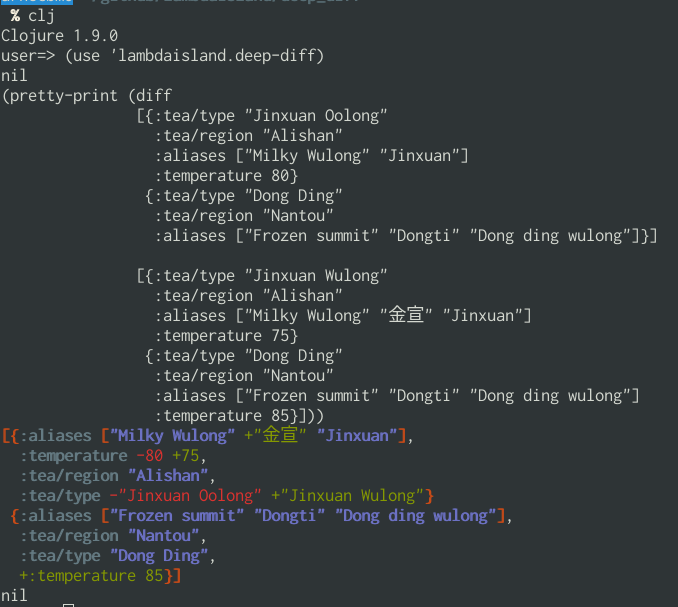
Output optimized for human consumption (e.g. deep-diff)
Has everything you would expect from a test runner in 2019.
$ clj -A:kaocha --watch
$ clj -A:kaocha --fail-fast
$ clj -A:kaocha --focus my.foo-test
Much more provided by plugins
(kaocha.repl/run)     ;; current ns
(kaocha.repl/run-all) ;; everything
;;=> #:kaocha.result{:count 7, :pass 5, :error 1, :fail 1}

(kaocha.repl/run 'my.foo-test 'my.bar-test/baz) ;; specific ns, var
(kaocha.repl/run {:fail-fast? true}) ;; extra config
magnars/kaocha-runner.el
liquidz/kaocha-nrepl
liquidz/vim-iced-kaocha
$ clj -A:kaocha --print-config
{:kaocha/tests [{:kaocha.testable/id   :unit
                 :kaocha.testable/type :kaocha.type/clojure.test
                 :kaocha/source-paths  ["src"]
                 :kaocha/test-paths    ["test"]
                 :kaocha/ns-patterns   ["-test$"]}]
 :kaocha/fail-fast? false
 :kaocha/color?     true
 :kaocha/reporter   [kaocha.report/dots]
 :kaocha/plugins [:kaocha.plugin/randomize
                  :kaocha.plugin/filter
                  :kaocha.plugin/capture-output]}
;; tests.edn
#kaocha/v1
{:tests    [{:test-paths ["test/clj"]}]
 :reporter [kaocha.report/documentation]
 :plugins  [:kaocha.plugin/notifier]}
#kaocha/v1 provides shorthand, defaults, and normalization.
(-> "tests.edn"
    kaocha.config/load-config
    kaocha.api/test-plan
    kaocha.api/run)
It’s just a data pipeline!
config —load—> test-plan —run—> test-result
Two data transformations, three data structures, each one augmenting the
previous one.
$ clj -A:kaocha --print-config
{:kaocha/tests
 [{:kaocha.testable/id   :unit
   :kaocha.testable/type :kaocha.type/clojure.test
   :kaocha/source-paths  ["src"]
   :kaocha/test-paths    ["test"]
   :kaocha/ns-patterns   ["-test$"]}]
 :kaocha/fail-fast? false
 :kaocha/color?     true
 :kaocha/reporter   [kaocha.report/dots]
 :kaocha/plugins [:kaocha.plugin/randomize
                  :kaocha.plugin/filter
                  :kaocha.plugin/capture-output]}
$ clj -A:kaocha --print-test-plan
{:kaocha/tests
 [{:kaocha.testable/id   :unit
   :kaocha.testable/type :kaocha.type/clojure.test
   :kaocha/tests ;; <-- new
   [{:kaocha.testable/id   :my.foo-test
     :kaocha.testable/type :kaocha.type/ns
     :kaocha/tests
     [{:kaocha.testable/id   :my.foo-test/bar-test
       :kaocha.testable/type :kaocha.type/var
       :kaocha.var/test      <test-fn>
       ,,,}]}]}]
 ,,,}
$ clj -A:kaocha --print-result
{:kaocha/tests
 [{:kaocha/tests
   [{:kaocha/tests
     [{:kaocha.testable/id    :my.foo-test/bar-test
       ;; v---- new
       :kaocha.result/error   0
       :kaocha.result/pending 0
       :kaocha.result/pass    0
       :kaocha.result/count   1
       :kaocha.result/fail    1
       :kaocha.result/events [{:file "foo_test.clj",
                               :type :fail,
                               :line 5,
                               :expected (= [2 8 5] (sort [4 8 2])),
                               }]
       ,,,}}]}]}]}
Everybody’s needs are different, people have strong opinions about testing and tools.
Solution: lean core, extensible architecture
Test types
Plugins
Reporters
(ns kaocha.type.cljs)

(defmethod kaocha.testable/-load :kaocha.type/cljs [testable]
  (merge testable child-tests-and-metadata))

(defmethod kaocha.testable/-run :kaocha.type/cljs [testable test-plan]
  (merge testable results))

(hierarchy/derive! :kaocha.type/cljs :kaocha.testable.type/suite)
(ns kaocha.plugin.version-filter)

(defn skip? [testable]
  (let [{:keys [min-clojure-version max-clojure-version]}
        (:kaocha.testable/meta testable)]
    ,,,))

(kaocha.plugin/defplugin kaocha.plugin/version-filter
  (pre-test [testable test-plan]
    (if (skip? testable)
      (assoc testable :kaocha.testable/skip true)
      testable)))
#kaocha/v1 {:plugins [:kaocha.plugin/version-filter]}
- or -
$ clj -A:kaocha --plugin version-filter
code
(deftest ^{:min-clojure-version "1.10"} my-spec-test
  ,,,)
cli-options config
pre-load post-load
pre-run post-run
wrap-run
pre-test post-test
pre-report
version-filter
notifier
profiling
randomize
junit.xml output
spect-test-check
…
Generates the actual output, basically an event handler.
This piggiebacks on clojure.test reporters, but made more general.
(defmulti my-reporter :type)

(defmethod my-reporter :kaocha/begin-suite [e]
  (print "["))

(defmethod my-reporter :kaocha/end-suite [e]
  (print "]"))

(defmethod my-reporter :kaocha/begin-group [e]
  (print "("))

(defmethod my-reporter :kaocha/end-group [e]
  (print ")"))
:fail, :error, :pass, :summary, …
Easiest way to start doing ClojureScript testing.
Uses ClojureScript’s repl-env abstraction under the hood.
#kaocha/v1
{:tests [{:id :frontend :type :kaocha.type/cljs}
         {:id :backend  :type :kaocha.type/clojure.test}]}
$ clj -A:kaocha frontend
$ clj -A:kaocha --help
USAGE: bin/kaocha [OPTIONS]... [TEST-SUITE]...

  -c, --config-file FILE     tests.edn  Config file to read.
      --print-config                    Print out the fully merged and normalized config, then exit.
      --print-test-plan                 Load tests, build up a test plan, then print out the test plan and exit.
      --print-result                    Print the test result map as returned by the Kaocha API.
      --fail-fast                       Stop testing after the first failure.
      --[no-]color                      Enable/disable ANSI color codes in output. Defaults to true.
      --[no-]watch                      Watch filesystem for changes and re-run tests.
      --reporter SYMBOL                 Change the test reporter, can be specified multiple times.
      --plugin KEYWORD                  Load the given plugin.
      --profile KEYWORD                 Configuration profile. Defaults to :default or :ci.
      --version                         Print version information and quit.
      --help                            Display this help message.
  -H, --test-help                       Display this help message.
      --[no-]randomize                  Run test namespaces and vars in random order.
      --seed SEED                       Provide a seed to determine the random order of tests.
      --skip SYM                        Skip tests with this ID and their children.
      --focus SYM                       Only run this test, skip others.
      --skip-meta SYM                   Skip tests where this metadata key is truthy.
      --focus-meta SYM                  Only run tests where this metadata key is truthy.
      --[no-]capture-output             Capture output during tests.